
- field service hiring strategy
- field service workforce planning
- investing in skilled trades talent
Buy-In, Budget, and Boots on the Ground: The Schneider Electric Leadership Formula
Key Takeaways:
Megan Schlam of Schneider Electric outlined a three-pillar leadership formula at Field Service Next West 2026 to address the skilled trades workforce shortage threatening every service-driven business by 2030.
- The “silver tsunami” is real. 50% of the skilled trades workforce is over 50, with a wave of retirements coming.
- Buy-In, Budget, Boots on the Ground: Three non-negotiable pillars for hiring at scale.
- The ROI is measurable. A $1M investment in wages and advertising returned $600K in overtime savings within a year.
- Hire for potential, not unicorns. The skill profiles tenured managers are looking for no longer exist in the open market.
- Treat hiring as a business strategy, not a transactional HR task. That’s how Schneider hired 350 technicians in one year.
How can field service companies fix the skilled trades workforce shortage?
By treating talent acquisition as a strategic business priority, not an HR checkbox, Megan Schlam of Schneider Electric argues that the answer is a clear field service hiring strategy built on three pillars: leadership buy-in, real budget commitment, and on-the-ground engagement at every step of the funnel.
A great hiring strategy needs a great operational backbone. Discover how Praxedo’s field service management platform helps service leaders grow their business without scaling headcount linearly, and track technician performance to identify retention and development opportunities early.
The Full Story
The skilled trades workforce is facing a “silver tsunami.” With 50% of the workforce over 50, the industry is braced for a massive wave of retirements by 2030. For Megan Schlam, Vice President of Services Execution (Operations, US) at Schneider Electric, this isn’t just a recruiting hurdle; it’s a leadership crisis that requires a new way of thinking about talent.
The Three Principles of Leadership Engagement
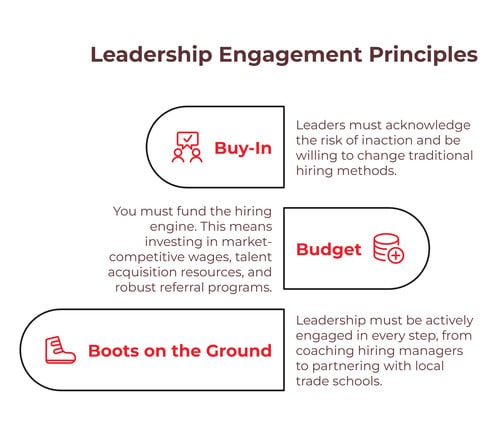
Schlam argues that successful hiring at scale is built on three pillars, the foundation of any modern field service hiring strategy:
- Buy-In: It is no longer enough to “open a req” and wait. Leaders must acknowledge the risk of inaction and be willing to change traditional hiring methods.
- Budget: You must fund the hiring engine. This means investing in market-competitive wages, talent acquisition resources, and robust referral programs.
- Boots on the Ground: Leadership must be actively engaged in every step, from coaching hiring managers to partnering with local trade schools.
The ROI of Investing in People
One of Schlam’s most compelling stories involved a distribution center that was plagued by mandatory overtime for 5 years. The facility had a “people problem” that was actually a staffing problem. Schlam made a “crazy” request for $1 million to fix wages and advertising. Within a year, the investment delivered a $600,000 reduction in annualized overtime, effectively paying for itself while boosting employee engagement.
In a separate manufacturing environment, this same focus on proactive hiring and reducing reliance on expensive contract labour drove $5 million in labour cost savings. The lesson is hard to ignore: investing in skilled trades talent is not a cost line; it’s one of the highest-return decisions a service operation can make.
Changing the Leadership Mindset
A significant part of this transformation is “change management.” Tenured hiring managers often move too slowly or look for “unicorns,” technicians with levels of expertise that no longer exist in the open market. Schlam emphasizes that organizations must instead hire for potential and rely on their internal training programs to bridge the skills gap. This shift is the heart of modern field service workforce planning: accepting that the talent pipeline you wish you had is gone, and building processes around the talent that’s actually available.
A Success Story in Numbers

The results of Schneider Electric’s adherence to this formula are impressive. Within a year, they had recruited 350 technicians, quadrupled their net headcount year-on-year, and slashed attrition. They are making a strategic business decision, not a transactional HR process, and their orange trucks will be on the road for years to come. Structured intake, leadership accountability, and consistent technician attrition reduction turned a chronic staffing problem into a competitive advantage.
Conclusion
Megan Schlam’s Buy-In, Budget, and Boots on the Ground formula offers a practical playbook for any service organization staring down the skilled trades workforce shortage. The point of the lesson is not that hiring is difficult, but that most companies still view hiring as a transactional process rather than a multi-year investment.
Three levers determine whether service businesses will succeed beyond 2030: investing in skilled trades talent, modernizing field service workforce planning, and committing to long-term technician attrition reduction. Done well, this is the formula that keeps trucks on the road, customers served, and operating costs predictable.
Request a demo with Praxedo to see how a unified field service platform can support your hiring strategy with the operational data and visibility your leaders need to make smart workforce decisions.
For more insights on scaling service operations, visit our resource center at Praxedo.com.
FAQs:
1. What is the “silver tsunami” in field service?
It’s the looming wave of retirements expected by 2030, driven by the fact that 50% of the skilled trades workforce is currently over 50 years old. The shortage of incoming talent makes the gap especially severe.
2. What are the three pillars of Schneider Electric’s hiring formula?
Buy-In (leadership commitment), Budget (real money for wages and recruiting), and Boots on the Ground (active executive involvement throughout the hiring funnel).
3. What ROI did Schneider Electric see from investing in hiring?
A $1 million investment in wages and advertising at one distribution center delivered $600,000 in annualized overtime savings in 12 months, while a separate manufacturing pivot drove $5 million in labour cost savings.
4. Why does Schlam say companies shouldn’t hire “unicorns”?
Because the highly tenured technicians some hiring managers want simply don’t exist in the open market anymore. Hiring for potential and investing in internal training is the only viable path forward.
5. How does a strong field service hiring strategy reduce attrition?
When companies pay competitively, engage leadership in retention, and invest in development, employees feel valued and engaged. Schneider’s holistic strategy proved a major success in retaining staff during a period of growth.
6. Why is field service workforce planning a leadership issue, not just an HR issue?
Hiring at scale requires sustained budget commitment, change management, and executive sponsorship. Treating it as an HR task alone is what causes most service businesses to fall behind their staffing targets.
