
- AI in field service management
- AI use cases in field service
- generative AI for field technicians
Creative AI Use Cases That Drive Efficiency, Customer Satisfaction, and Growth
Key Takeaways:
Dr. Haroon Abbu’s fireside chat unpacked some of the most practical AI use cases in field service today, showing how Bell and Howell engineered a 53% lift in daily service calls per technician without adding a single new hire.
- The “multiplier effect” reframes AI as a way to amplify expert technicians rather than replace them.
- A Pre, During, and After lifecycle turns abstract AI ambition into deployable steps tied to real workflow stages.
- Generative + Discriminant AI working together lets technicians query manuals and live inventory in a single interface.
- Adoption beats metrics in early rollouts, proving the tool feels like a partner before chasing time-saved KPIs.
- 53% more calls per technician, no added headcount, and a “Best Service Support Strategy Implementation” award.
How do field service organizations actually deploy AI without disrupting technicians?
By breaking AI into the three natural phases of a service call. Dr. Haroon Abbu of Bell and Howell explained that his team organized AI use cases in field service around Pre-work, During-service, and After-action debriefs, which lets each AI tool earn trust on a specific job and grow from there.
The same Pre/During/After lifecycle Bell and Howell describes maps directly to how field teams capture work today. Praxedo’s mobile-first work order platform pairs offline-ready job briefs with structured post-visit reports, giving AI a clean data layer at every stage of the call.
The Full Story
In the rapidly evolving world of field service, the conversation has shifted from “if” organizations should adopt Artificial Intelligence to “how” they can deploy it to achieve measurable results. During a recent industry session, Dr. Haroon Abbu of Bell and Howell shared a masterclass in AI implementation, revealing how they leveraged creative use cases to drive a staggering 53% increase in service calls per technician, per day.
This transformation wasn’t about replacing humans; it was about the “multiplier effect”: using technology to amplify the expertise of a workforce increasingly tasked with servicing complex, multi-vendor industrial automation equipment.
The Pre, During, and After: Organizing the AI Lifecycle
To make AI actionable, Abbu’s team organized their strategy into three distinct phases of a service call: Pre-work, During-service, and After-action debriefs.
1. The Pre-Work Brief: Automating the Research
The most immediate area for optimization was the “pre-work” phase. Traditionally, a technician spends significant time researching a call: looking for parts, reviewing previous service notes, and digging through manuals. Bell and Howell’s AI now performs this research automatically, providing a structured brief.
Crucially, the organization prioritized adoption over metrics in the early stages of field service AI implementation. Instead of strictly measuring time saved, they focused on whether technicians were getting the specific information they needed to feel prepared. This approach ensured the tool was viewed as a partner rather than a monitor.
2. During Service: Knowledge Management at the Point of Work
Technicians at Bell and Howell are often required to possess an average of 14 distinct skills, enabling them to service machines from a wide variety of Original Equipment Manufacturers (OEMs). This level of complexity makes traditional manuals insufficient.
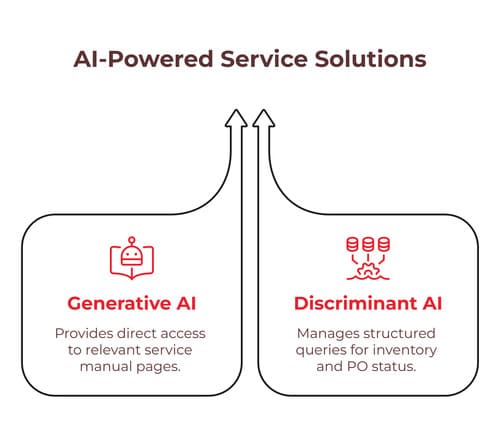
To solve this, they implemented a Retrieval-Augmented Generation (RAG) system using vector databases. This creative system combines two distinct AI styles and is one of the cleanest examples of generative AI for field technicians working alongside structured data systems:
- Generative AI: Ingests years of service manuals and resolution notes to take a technician directly to the relevant page for a specific issue.
- Discriminant AI: Handles structured queries, such as checking live inventory levels or the status of incoming Purchase Orders (POs).
By merging unstructured documentation with structured supply chain data, technicians can diagnose problems and confirm part availability in a single seamless interface.
3. After Action: Closing the Data Loop
The “after” phase focuses on the automated debrief. By using AI to summarize interactions and update knowledge bases in real time, the organization ensures that a senior technician’s “tribal knowledge” is captured and made available to the next person facing a similar issue.
Results: Winning with People, Process, and Technology
The most compelling aspect of this journey is the outcome. Bell and Howell received an award for Best Service Support Strategy Implementation after proving they could increase daily call volume by over 50% without adding headcount, a textbook case of AI-powered technician productivity delivering board-level results.
The success was attributed to a tech stack that includes:
- Salesforce FSL for field service management.
- Snowflake and Tableau for data analytics.
- OpenAI with Codex and Amazon S3 for the custom knowledge base.
The Role of the Subject Matter Expert (SME)

A critical takeaway for the audience was the continued importance of Subject Matter Experts. While platforms like Kaggle provide open-source algorithms, Bell and Howell found that AI tools only succeed when developed in proximity to the business operations. The goal is the intersection of data technology and the people on the front lines.
As Abbu noted, “Installation and repair is an area ripe for AI because it improves the customer experience while giving technicians more time to actually work on the machines.” By automating the routine, organizations can finally unlock the creative potential of their workforce.
Conclusion
What makes the Bell and Howell story stand out isn’t the 53% productivity number; it’s the discipline behind it. Treating AI as a partner to skilled technicians, anchoring deployment to real workflow phases, and letting SMEs co-design the tools turned a buzzword into a measurable AI multiplier effect.
The deeper lesson for service leaders is that field service AI implementation doesn’t reward the company with the biggest budget; it rewards the company with the cleanest workflow and the most engaged technicians. When those two ingredients are in place, even modest AI investments compound quickly, and the AI multiplier effect stops being a slide and becomes a quarterly result.
If you’re thinking about where to start your own version of this playbook, the smallest unit of progress is a structured work order. Walk through a Praxedo platform tour to see how a unified mobile workflow gives your future AI initiatives the clean data foundation they need from day one.
Praxedo’s practical guides for service leaders go deeper into the operating habits that compound this kind of AI-powered technician productivity across industries from HVAC to Plumbing.
FAQs:
1. What is the “AI multiplier effect” in field service?
Bell and Howell’s tagline for AI is that it is not meant to replace skilled technicians but to amplify them. The aim is to remove experts from repetitive tasks and allow them to focus on the more complex tasks that only humans can perform.
2. How did Bell and Howell increase service calls per technician by 53%?
Through pre-work research automation, point-of-work generative AI for field technicians, and AI-generated de-briefs. The cumulative time savings enable each tech to process many more calls per day.
3. What is a Retrieval-Augmented Generation (RAG) system, and why does it matter here?
It’s an AI architecture that retrieves relevant information from a knowledge base before generating an answer. Bell and Howell employed it to integrate years of service manuals with live inventory and PO data in a single interface.
4. Why did Bell and Howell prioritize adoption over metrics early on?
Adoption creates trust, and trust unlocks data quality. Technicians found that when they felt the AI was assisting them, they provided it with more inputs, and the metrics improved naturally.
5. What role do Subject Matter Experts (SMEs) play in successful field service AI implementation?
A decisive one. Open-source algorithms are commodities; SMEs are the differentiator because they can turn business context into the right prompts, datasets, and workflows. AI tools don’t work when they are developed away from the front lines.
6. What tech stack powered Bell and Howell’s AI-powered technician productivity gains?
Salesforce FSL for field service management, Snowflake and Tableau for analytics, and OpenAI with Codex plus Amazon S3 for their custom knowledge base. It is not so much the mix as the degree of integration.

Our similar articles.
-
- Field Service Management
- Field Service Software
- mobile
- AI in field service management
The Power of Mobile-First: Why Mobile Devices Are Critical for Digital Transformation in Field Service Management
December 5, 2023
-
- fsm
- AI in field service management
- Heavy equipment
- heavy equipment management software
How Software for Equipment Dealers Can Streamline Operations
November 18, 2025
-
- AI in field service management
- best of breed fsm
- best-of-breed solutions
The Right Fit: When to Choose Best-of-Breed over a General FSM for Small Businesses
July 24, 2026