
- Heavy equipment
- heavy equipment management software
Paperwork Kills Profit: How to Digitally Bulletproof Your Heavy Equipment Fleet for Audits and Warranty Claims
Key Takeaways:
Before diving in, here’s what every rental operator should know about the silent profit drain of paper records:
- Weakened Warranty Positions: Lost or illegible notes make it incredibly difficult to successfully file heavy equipment warranty claims with manufacturers (OEMs).
- Dreaded Audits: Going digital creates a timestamped trail that auditors and OEMs accept without pushback, turning compliance into a routine.
- Protected Revenue: A comprehensive fleet maintenance software captures the exhaustive service history needed to protect your bottom line during disputes.
- Reduced Disputes: Digital photos and signatures make drop-off and return disputes a thing of the past.
- Rapid ROI: The right fleet management solutions for heavy equipment typically pay for themselves within 6 to 12 months.
Every rental operator has felt it: a technician wraps up a job, scribbles on a carbon copy, tosses it onto the dashboard, and two weeks later, accounting is still hunting for the ticket. That isn’t a nuisance. It’s lost revenue walking out the door. Disorganized records also undermine your case when you need to make claims under warranties for heavy equipment, and they turn an audit into a nightmare.
Digital solutions address all of these issues. A good heavy equipment fleet management system automatically logs inspections, service details, photos, and signatures, converting free-form documents into a searchable database your entire team can access in a matter of seconds. The difference between a profitable rental business and one that struggles to make ends meet is often the speed with which that information gets back to the office.
The Hidden Cost of Paper in a Rental Fleet
Paper looks cheap. It isn’t. Operators leaning on paper-based processes typically face three recurring losses.
The first is slow invoicing. When a handwritten job ticket has to travel from truck to dispatch to accounting before billing goes out, you’re often waiting a week before a single dollar is recovered. That delay compounds across hundreds of jobs per month. Praxedo customer JLR Grues saw this pattern disappear once they moved to digital workflows, sending invoices the same day work was completed.
The second is dispute exposure. Without a date-stamped photo showing equipment condition at drop-off and return, damage arguments become “your word against theirs.” You usually pay the cost.
The third is weak documentation during compliance reviews. Auditors and manufacturers both want clean records on demand. If yours are scattered across binders, gloveboxes, and shared drives, you won’t find them in time.
More than 8 in 10 industrial decision-makers say unplanned equipment downtime costs at least $10,000 per hour (ABB, 2025). For rental operators, much of that cost traces back to paper-based processes, a missing service log, an unreadable inspection form, or a work order that took three days to reach the maintenance manager.
Switching to modern heavy equipment fleet management tools eliminates all three issues at once. Dispatchers, technicians, and finance teams share a single source of truth, updated in real time from the field.
Why Auditors and Manufacturers Care About Clean Records
Documentation Strengthens Every Warranty Position
Manufacturers don’t reject claims casually; they reject those that lack proof. When filing under heavy equipment warranties, OEMs want to see evidence of scheduled maintenance, the exact part numbers installed during service, current hour-meter readings, and photos of the fault before any repair begins.
Digital systems capture all of this as a byproduct of normal work. A technician snaps photos, selects parts from a catalogue, and logs hours against the asset’s serial number. Months later, when a question arises, the supporting evidence is already waiting. That’s the quiet value of good heavy equipment fleet maintenance software; it doesn’t run the claim process itself, but it makes every dispute significantly easier to defend.
For a typical rental operation, recovering even a handful of previously rejected claims each year is often enough to pay for the platform several times over.
Safety Reviews Demand Retrievable Records
Heavy equipment safety auditing reviews have tightened noticeably over the past few years. Inspectors now expect timestamped inspection logs, signed checklists, operator certifications, and a clean incident history, all of which are retrievable within minutes. Paper binders can’t deliver that kind of access. Digital platforms can.
When records are structured, searchable, and complete, reviews shift from fire drills into routine exercises. You stop dreading that knock on the door.
Five Digital Capabilities That Protect Your Fleet

Not every platform delivers what rental operators actually need. Here’s what to look for when evaluating options.
1. Centralized Equipment History
Every asset should have a digital profile that includes purchase details, service logs, attached documents, and field photos. Centralization is the core value of heavy equipment fleet management software. When a question arises about a specific crane or excavator, everything lives in one place, accessible to dispatch, maintenance, and accounting alike.
Onboarding new staff also moves faster because they no longer have to chase tribal knowledge across the organization.
2. Logistics and Work Order Visibility
Heavy equipment fleet tracking in a field service context means real-time visibility into deliveries, pickups, maintenance visits, and technician schedules. Dispatchers see the day’s workload on a map, customers receive automated arrival alerts, and nothing falls through the cracks.
This is logistical visibility of jobs and movements, not telematics installed on the machine itself.
3. Digital Forms and Photo Capture
Photos with time, date, and location stamps eliminate condition disputes. Checklists become inspection forms that automatically update compliance databases. Workers no longer carry clipboards, and information is transmitted in real time rather than at the end of the day.
Combined with signed delivery receipts, these habits form the foundation of the best heavy equipment fleet safety monitoring practices for rental operators.
4. Parts and Inventory Visibility
Robust heavy equipment fleet inventory software tracks spare parts by supplier, install date, and serial number. Technicians log which approved components were installed during service, ensuring accurate records for every asset in the yard and reducing downtime when items need to be reordered.
5. Rental-Specific Workflows
Generic field service tools miss the nuances of renting assets. Purpose-built fleet and heavy equipment rental software adds delivery and pickup flows, condition reports, damage attribution, and automated billing reconciliation. These workflows separate rental-ready systems from generic tools that leave gaps in how you manage assets as they come and go from job sites. Operators like Kiloutou and JLR Grues rely on Praxedo for exactly these functions.
The 6-Point Readiness Checklist
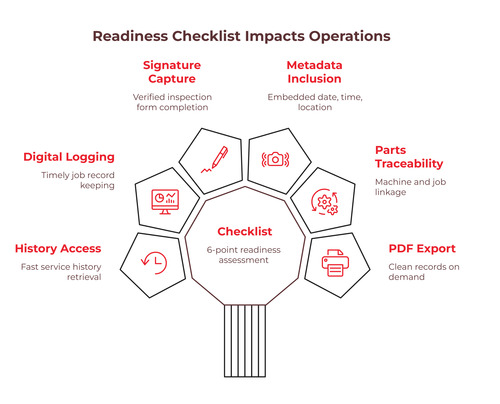
Run through these questions honestly. Your answers will reveal exactly where the gaps are.
- Can you pull the full service history for any asset in under 60 seconds?
- Is every job logged digitally within 24 hours of completion?
- Do inspection forms carry signatures and timestamps?
- Do your field photos include embedded date, time, and location metadata?
- Is parts usage traceable back to a specific machine and job?
- Can your team export clean PDF records on demand for an OEM rep or auditor?
If you answered “no” to two or more of these, the paper is actively draining profit right now.
What to Look for in Fleet Management Software
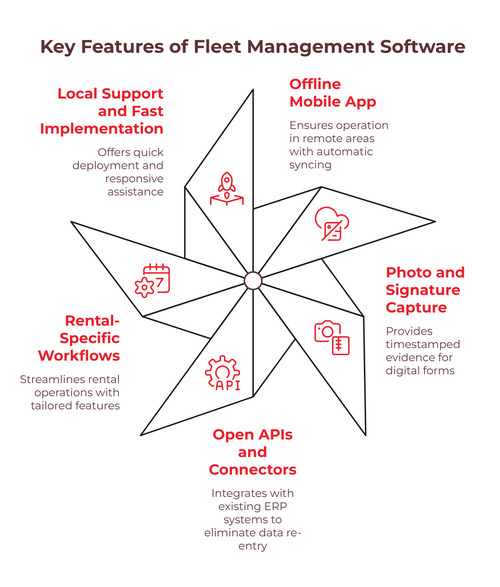
Several key characteristics distinguish fleet management solutions for heavy equipment that are ready for rental from those that are not. When shopping, look for:
- Offline mobile app: Field crews need to operate on remote job sites where connectivity is lost, with data automatically syncing when they return to coverage.
- Built-in photo and signature capture: Time-stamped, date-stamped, location-stamped evidence should be an integral part of every digital form.
- Open APIs and pre-built connectors: Integration with your existing ERP (SAP, Salesforce, Microsoft Dynamics 365 Business Central, QuickBooks) eliminates data re-entry.
- Rental-specific workflows: Delivery logs, pickup schedules, condition reports, and damage attribution features built for how rental operations actually run.
- Local support and fast implementation: A team that helps you deploy in weeks rather than months, with responsive support once you’re live.
A specialized heavy equipment fleet inventory software stack, integrated with maintenance and dispatch, outperforms bolted-on ERP modules every time. Purpose-built platforms are designed around field realities: dust, rain, spotty coverage, rather than retrofitted from accounting tools.
Implementation speed also matters. A system that takes six months to deploy delays every benefit; one that goes live in weeks starts paying back immediately. Praxedo held a multi-year streak in Gartner’s Magic Quadrant from 2016 through 2022 for exactly this kind of specialization, which is why rental operators across North America and Europe choose it.
Conclusion
Paper doesn’t just slow things down. It weakens your position in every important conversation: with customers, with manufacturers, and with auditors. Moving to digital records closes those gaps and turns documentation from a liability into a durable business asset.
Strong record-keeping runs on clean data, timely updates, and retrievable evidence. Book a demo with Praxedo to see how rental companies are replacing paperwork with profit.
FAQs:
1. What does a digital platform actually do for a rental fleet?
It digitizes the full service cycle, storing every inspection, delivery, repair, and signature in one searchable system accessible to your entire team instantly.
2. How does going digital support warranty claims?
Capturing service history, part numbers, and field photos creates an evidence trail that makes warranty disputes for heavy equipment much easier to resolve.
3. Can it handle rental-specific workflows?
Yes. A purpose-built fleet and heavy equipment rental software includes delivery scheduling, timestamped condition photos, signed handover receipts, and automated damage attribution to reduce disputes.
4. What kind of tracking does it provide?
Heavy equipment fleet tracking here means real-time logistical visibility into jobs, technician locations, and delivery schedules, not GPS telematics mounted on individual machines.
5. How does it support safety reviews?
Digital forms, signed checklists, and retrievable photo evidence anchor the best heavy equipment fleet safety monitoring practices, providing auditors with the records they expect during reviews.
6. Will it connect to our existing systems?
A modern heavy equipment fleet management software integrates with SAP, Salesforce, QuickBooks, and Microsoft Dynamics via pre-built connectors, eliminating duplicate data entry across departments.

Our similar articles.
-
- fsm
- AI in field service management
- Heavy equipment
- heavy equipment management software
Benefits of Combining IoT with Heavy Equipment Rental Management Software
Februar 4, 2026
-
- fsm
- AI in field service management
- Heavy equipment
- heavy equipment management software
Streamline Equipment Tracking With Heavy Equipment Management Software
September 30, 2025
-
- fsm
- AI in field service management
- Heavy equipment
- heavy equipment management software
How Software for Equipment Dealers Can Streamline Operations
November 18, 2025