
- driver behavior monitoring
- fleet safety ROI
- proactive safety culture
- video telematics for field service
Proactive Prevention: The Strategic Marriage of Video and Telematics
Key Takeaways:
A fireside chat between Lytx and Geotab made the case that video telematics for field service is no longer a “nice to have,” it’s the operational engine behind safety, savings, and culture change.
- The marriage of video and telematics moves operations from the “what” of a data point to the “why.”
- Real-time AI alerts cut dangerous driving behaviors by 45%, turning behavior correction into a daily habit.
- Lytx helped drive a $1.9 billion reduction in claims and workers’ comp costs for customers in 2025.
- Collisions in service rose 5% year over year, largely due to inattentive driving and rising workloads.
- “Just culture” beats Big Brother: the right rollout drives near-zero attrition and stronger driver engagement.
How does combining video and telematics actually reduce field risk?
By giving managers the context behind every data point. As Barret Van Allen of Geotab explained, a telematics-only “harsh braking” alert can be misread as reckless driving. Add video, and the same event might reveal a technician avoiding a child in the road, or, conversely, expose unoptimized routing that pushes drivers into unsafe shortcuts.
For nearly three decades, video safety and telematics operated as separate silos in the field service industry. Telematics focused on operational efficiency (routing, fuel, and diagnostics), while video was strictly for safety and risk mitigation. However, as industry leaders Geotab and Lytx recently shared, bringing these two capabilities together creates a “one-stop shop” for organizational health.
Safer fleets start with smarter operations. See how Praxedo’s field service management platform and AI-powered scheduling reduce the time pressure that drives risky behavior in the first place.
Beyond the “What” to the “Why”

The true value of integrated systems lies in providing the context behind a data point. Barret Van Allen of Geotab noted that a traditional telematics system might flag a “harsh braking” event. Without video, a manager might assume the driver was reckless, leading to a negative disciplinary conversation.
Integrated video reveals the truth: perhaps the technician braked to avoid a child or an animal darting into the road. In this scenario, what was once a negative event becomes a moment of praise for a technician’s attentiveness. Conversely, video might show that a technician is blowing stop signs because their routing is unoptimized, causing them to feel extreme time pressure. This is the core power of video telematics for field service: context-rich coaching instead of reactive discipline.
The ROI of Safety: $1.9 Billion in Saved Costs
fleet-safety-ROI.jpg
Safety is no longer a reactive requirement; it is an operational engine. According to Lytx’s annual road safety report, which is based on 350 billion miles of data, service industry collisions rose 5% year-over-year. This rise is primarily due to distracted driving, as technicians are increasingly overwhelmed with work and distractions, making driver behavior monitoring more important than ever.
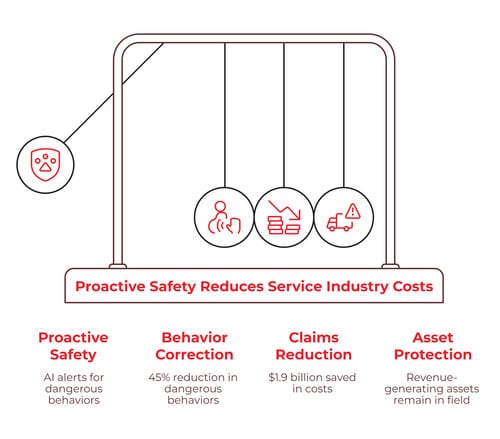
The financial impact of a proactive safety culture is immense:
- Behavior Correction: Implementing real-time, in-cab AI alerts for behaviors such as cell phone use or following too closely reduces those dangerous behaviors by 45%.
- Claims Reduction: In 2025 alone, Lytx helped drive a $1.9 billion reduction in claim costs and workers’ compensation for its customers, a clear demonstration of fleet safety ROI at scale.
- Asset Protection: Even minor incidents can take revenue-generating assets out of the field, impacting the bottom line beyond the immediate repair cost.
When the math is this clear, fleet safety ROI stops being an annual report figure and starts being a board-level priority.
Overcoming the “Big Brother” Cultural Barrier
The most common concern for organizations is employee attrition, the fear that technicians will quit if a camera is installed. Barret Van Allen suggests that successful change management relies on a “just culture” in which the focus is not on “getting” the employee but on “having their back.”
Newer features like fatigue detection focus on the fact that these tools are designed to keep the driver safe from accidents that they did not intentionally cause, such as dozing behind the wheel. Many Geotab customers reported no attrition after deployment, saying that being open and honest with drivers and union leaders about the “exoneration piece” (proving a driver wasn’t at fault in an accident) creates long-term engagement and shared values. That’s how a proactive safety culture takes root: not through surveillance, but through advocacy for the driver.
Conclusion
One thing was evident during the Lytx and Geotab fireside chat: AI fleet safety is not just a risk-mitigation tool, it’s a competitive advantage in plain sight. Video and telematics combine to provide service organizations with the “why” behind each data point, transforming driver behavior monitoring from a punitive process to a coaching opportunity.
$1.9 billion in customer savings doesn’t just happen, and neither does a proactive safety culture that keeps technicians safe, protects them when they’re not at fault, and rewards good driving in real time.
The journey to operationalizing AI fleet safety begins with cleaner data, seamless tools, and an open dialogue with your drivers about who the technology truly serves.
Request a demo with Praxedo to see how a unified field service platform reduces the time pressure that drives risky behavior, supporting safer outcomes across HVAC & Refrigeration, Telecommunications, and beyond.
FAQs:
1. What is video telematics for field service?
It’s the integration of telematics data (location, routing, diagnostics) with in-cab video to give managers full context behind every driving event. The combination enables coaching, exoneration, and behavior change.
2. How much can AI fleet safety actually save?
Lytx reported helping its customers achieve a $1.9 billion reduction in claim costs and workers’ compensation in 2025, along with a 45% drop in dangerous in-cab behaviors enabled by real-time alerts.
3. Why are collisions rising in the service industry?
According to Lytx’s road safety data, service-industry collisions rose 5% year-over-year, driven largely by inattentive driving as technicians face heavier workloads and more distractions.
4. How does driver behavior monitoring avoid feeling like Big Brother?
By framing video as a “just culture” tool that protects the driver, not surveils them. Capabilities like fatigue detection and exoneration evidence build trust rather than erode it.
5. What is the “exoneration piece” in fleet safety?
It’s the ability to use video to prove a driver wasn’t at fault in an accident. This protection of innocent drivers is one of the strongest drivers of engagement in fleet safety rollouts.
6. How can a fleet roll out video telematics without losing drivers?
By communicating openly with drivers and union leaders, focusing on advocacy over discipline, and emphasizing the protective benefits. Many Geotab customers reported zero attrition after deployment.
