- customer service excellence
- global local service excellence
- service excellence training
Scaling the Global Giant: Siemens’ Blueprint for Global-Local Service Excellence
Key Takeaways:
At Field Service Next West 2026, Siemens revealed how a 100-year-old global organization scales customer service excellence without losing the local trust that customers actually buy into.
- Globalize the “How,” localize the “Who,” and centralize your global tech stack while keeping technicians, sales, and customer relationships local.
- Centralize AI in a Digital Service Center (DSC) to capture knowledge and avoid skill gaps from retirements.
- Move from tasks to outcomes, reframe the service mission from preventative maintenance to uptime and efficiency.
- Siemens rolled out 10 AI use cases in 9 months because the global tech stack was already in place.
- Structured service excellence training ensures local teams can deliver on global standards while maintaining customer intimacy that leads to loyalty.
How does a global organization standardize field service processes?
Brad Haeberle of Siemens Smart Infrastructure suggests using a “Franchise and Governance” model. Countries are given total flexibility in how they go to market and manage relationships. Still, they must operate within a standardized, global technology stack “box” to ensure data consistency and scalability.
Scaling a global team requires a unified view of your operations. Learn how Praxedo’s field service management software helps you balance global standards with local flexibility through deep ERP/CRM connectors and APIs.
The Full Story
Can a massive industrial organization maintain the intimacy of a local “mom-and-pop” shop while scaling global digital services? Brad Haeberle, Executive Vice President of Services for Siemens Smart Infrastructure, says the answer lies in the delicate balance between what you globalize and what you fiercely protect at the local level.
At Field Service Next West, Haeberle shared the transformation journey of Siemens, from a collection of siloed country-based businesses into a unified, outcome-oriented global power. The framework he credits with this transformation is what he calls the ‘Franchise and Governance’ model, a framework rooted in the importance of service excellence as both a cultural value and an operational system.
The Three Pillars of Decision Making
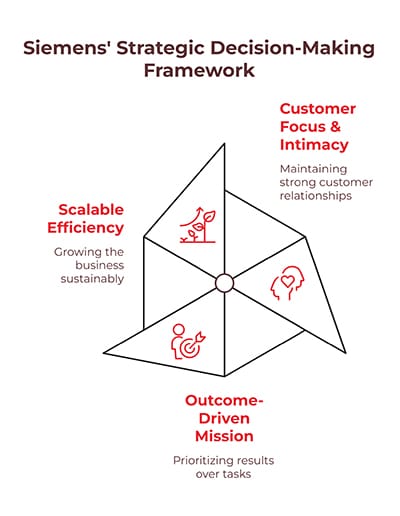
Haeberle emphasized that every strategic choice at Siemens passes through a specific lens to ensure global consistency without losing local value:
- Customer Focus & Intimacy: Never lose the relationship. Customers often buy because of a specific local technician or salesperson.
- Outcome-Driven Mission: Moving from “tasks” (preventative maintenance) to “outcomes” (guaranteed uptime and efficiency).
- Scalable Efficiency: Growing the business without simply adding more headcount, a goal that closely echoes how leaders today are growing their service business through smarter operations rather than headcount.
What to Globalize vs. What to Localize
Siemens’ success came from a clear “Playbook” on where to centralize and where to empower the local teams.
1. The Global Mandate: The “Tech Stack Box.”
Standardization is the hardest part of the journey, but Haeberle noted it is the most vital.
- The Unified Tech Stack: Siemens standardized their technology for operational delivery. While regional teams are encouraged to innovate, they must deliver those innovations within the global tech stack “box.” This ensures consistent reporting and data analysis.
- Digital Service Centers (DSC): Siemens centralized their AI-based analytics and “above-site” services. By creating a global distributed team, they ensured that if an expert in one country retires, the global business doesn’t lose that capability.
2. The Local Mandate: Relationship & Execution
Some things simply cannot be run from a headquarters in Switzerland or Germany.
- On-Site Operations: Technicians are embedded locally to maintain rapid response and deep site knowledge.
- Sales & Customer Success: Relationship management remains local. Haeberle noted that when he asks customers why they buy Siemens, they don’t name the technology; they name the local technician. This is excellence in customer service at its most tangible: the human connection that no algorithm can replicate.
- Language & Tribal Knowledge: Remote resolution teams are kept local/regional to handle language barriers and the specific “tribal knowledge” required for unique building infrastructures.
Breaking the “Standardization” Barrier
One of the most candid moments of the session was Haeberle’s reflection on the difficulty of change management.
“Everyone believes in standards… as long as it’s their standard,” Haeberle quipped.
Moving a 100-year-old organization with no history of standardization into a unified global process required tough conversations. The key learning? You cannot scale through “grunt force people.” You must use a standard platform to enable seamless information flow from an AI alert to a technician’s mobile device and, finally, to a customer report. Service excellence training at the local level becomes essential to ensure adoption, because even the best platform fails without people who understand how to use it.
The Secret Weapon: Infrastructure for AI

Because Siemens spent the last five years building this “Global-Local” infrastructure, they were able to deploy 10 AI use cases in just 9 months.
Without a standard tech stack, AI is just a “nice-to-have” local experiment. With the infrastructure in place, AI becomes a global profit engine that improves customer satisfaction at scale, turning delivering service excellence from an aspiration into a measurable, repeatable system. See how Praxedo’s AI-powered scheduling puts a similar principle into practice for service teams.
Brad Haeberle’s message was clear: in the race for service dominance, the winners will be those who can leverage global data while maintaining a local heart. The importance of service excellence isn’t a marketing slogan; it’s the strategic anchor that decides whether scale enhances or erodes customer trust.
Conclusion
Siemens’ global-local playbook proves that scaling a service business isn’t a choice between standardization and intimacy; it’s about engineering both into the same operating model. By locking down the technology stack while preserving the local relationships customers actually care about, Siemens transformed a century-old, decentralized organization into a global outcome machine.
For any service leader looking to deliver service excellence at scale, the takeaway is this: build the technology stack, train your people, and leverage AI to enhance your local teams’ work. Want to see how a single field service platform can help you achieve the same? Request a demo with Praxedo.
This session was a part of Field Service Next West. For more insights on global service scaling and digital transformation in industries like Energy & Utilities, visit our resource center at Praxedo.com.
FAQs:
1. What is the “Franchise and Governance” model in field service management?
It’s a model where local teams are completely independent in managing customer relationships and go-to-market, but must use a global technology stack to ensure data consistency.
2. Why did Brad Haeberle stress localizing technicians and sales teams?
Because people buy from people. Ultimately, the quality of customer service is determined by the local technicians and salespeople who build trust, possess language skills, and have local knowledge.
3. What is a Digital Service Center (DSC) and why does Siemens use one?
A DSC is a centralized hub for AI-based analytics and remote expert support. Siemens uses it to retain knowledge globally so that retirements or regional gaps don’t erode service capability.
4. How fast can a company deploy AI in field service with the right infrastructure?
Siemens deployed 10 AI use cases in just 9 months, but only because 5 prior years of standardizing the global tech stack made AI deployment plug-and-play.
5. What’s the difference between task-based and outcome-based service?
Task-based service focuses on completing scheduled maintenance. Outcome-based service guarantees results, like uptime, efficiency, or performance, and is the model Siemens is shifting toward.
6. How does customer service excellence connect to global field service strategy?
Only when global standards (technology, data, process) are in place can local teams focus on relationships, the part of the experience customers remember.
