
- data discipline for predictive service
- proactive field service
- proactive service models
- reliability analytics for predictive maintenance
The Great Service Race: Why Proactive Is the Only Way Forward
Key Takeaways:
A panel at Field Service Next West 2026 brought together leaders from IBM, Ford, Schneider Electric, KLA, and Fortis to make one case clear: the move toward proactive service models is no longer optional; it’s the competitive line between service leaders and laggards.
- The best service call is the one that never happens; the new mantra reframes service from reactive cost to predictive value.
- Three pillars enable the shift: disciplined data, agentic AI, and human-centric design.
- 75–85% of SME equipment lacks IoT connectivity, so reliability analytics fills the gap for “dark assets.”
- Agentic AI works 24/7, classifying cases, finding correlations, and predicting needs faster than manual workflows.
- Customer obsession is the endgame: unifying internal voices to solve problems before customers know they have them.
What does it actually take to move from reactive to proactive field service?
A clean data foundation first, then automation. The panel agreed that predictive maintenance in field service only works once organizations consolidate ERP and CRM systems, layer in agentic AI for continuous monitoring, and pair both with human judgment for the calls AI shouldn’t make alone.
In the rapidly evolving field service landscape, a new mantra has emerged: the best service call is the one that never happens. At a recent industry panel featuring leaders from IBM, Ford, Schneider Electric, KLA, and Fortis, the conversation centered on the urgent transition from reactive “firefighting” to a proactive, predictive model.
Wondering where to start the proactive shift? It begins with structured field data flowing back into clean systems of record. Praxedo’s ERP and CRM connectors eliminate the data fragmentation that stalls most predictive programs before they begin, and the customer portal closes the loop between technicians and the customers they’re trying to delight.
The Competitive Mandate
Proactive service models are no longer a luxury, but a competitive necessity. Industries are increasingly shifting to high-speed, high-stakes operations, and customers are turning to providers who can predict problems before they become problems. Organizations that continue to operate in a reactive mode risk falling behind as their peers redefine customer value with precision and waste elimination, driven by predictive maintenance in field service.
The Foundation of Data and Agents
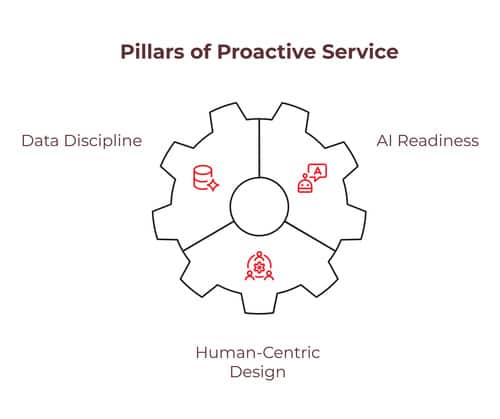
To successfully cross the chasm to proactive service, companies must master three core areas:
- Data Discipline: Leaders emphasized that data is the absolute foundation. Many organizations have spent years cleaning up multiple ERP and CRM systems to reach a point where predictive service is even possible. Without that data discipline for predictive service, every downstream AI initiative becomes an expensive guess.
- AI Readiness: We are entering an era of “Agentic AI,” where digital agents work 24/7 to classify cases, identify correlations, and predict human needs with greater accuracy than manual processes. This is the operational backbone of agentic AI in field service, freeing humans from the work AI does better.
- Human-Centric Design: Even with the advent of automation, there is a general agreement that a “human-in-the-loop” approach is essential. AI should be used to augment humans, not replace the valuable intuition of a skilled technician.
Solving the “Dark Asset” Problem
One of the most sobering challenges discussed was the lack of connectivity in existing equipment. According to the panel, reports suggest that in small- to mid-sized enterprises, 75% to 85% of equipment lacks basic IoT connectivity. Even in large enterprises, nearly half of all assets remain “in the dark.”
Vasiliy Krivtsov of Ford provided a pragmatic solution for these disconnected assets. By leveraging reliability analytics for predictive maintenance and historical failure data, companies can still apply classical statistics to predict failure probabilities. This allows for “intelligent maintenance intervals” that optimize costs without needing real-time telemetry from every machine. In other words, reliability analytics for predictive maintenance turns the dark asset problem from a blocker into a calculable risk.
Redefining the Customer Relationship

Ultimately, the goal is “customer obsession.” Megan Schlam of Schneider Electric noted that the transformation involves asking customers what they need rather than telling them. By addressing internal communication challenges and unifying the company’s voice, organizations can solve problems before customers even realize they exist.
Conclusion
The panel’s collective signal was unmistakable. Service organizations that wait for things to break are racing in the wrong direction. The winners are the ones building proactive service models on three reinforcing layers: clean data, intelligent agents, and human judgment that knows when to override them. Data discipline for predictive service isn’t the glamorous part of the journey, but it’s the only part that makes everything else possible.
Combined with agentic AI in field service that works around the clock, and reliability analytics that solve the dark asset problem head-on, the result is a service organization that customers don’t just keep, they prefer.
If you’re sizing up where to begin, look at the boundary between your technicians and your systems of record. That’s where most data quality issues are born, and where most proactive programs win or lose. Book a personalized walkthrough of Praxedo to see how cleaner field capture sets up everything that comes after.
For service leaders working through this shift in Energy & Utilities or Plumbing, Praxedo’s growth and loyalty playbook goes further on operating habits that compound the proactive shift.
FAQs:
1. Why are proactive service models a competitive necessity now?
Because customers are increasingly choosing providers that prevent downtime rather than react to it. Reactive service organizations lose share quickly once competitors prove they can anticipate failures.
2. What are the three pillars of a proactive field service strategy?
Data discipline, agentic AI, and human-centric design. All of them support each other, and omitting any one pillar weakens the whole transformation.
3. How does agentic AI in field service differ from traditional automation?
Traditional automation follows fixed rules. Agentic AI runs continuously, classifying cases, hunting for correlations, and making predictions, often catching issues that scripted systems miss entirely.
4. What is the “dark asset” problem in industrial service?
The reality is that most installed equipment, especially in SMEs, lacks IoT connectivity. Up to 85% of SME assets and roughly half of large-enterprise assets remain disconnected from any monitoring platform.
5. How can reliability analytics for predictive maintenance help if assets aren’t connected?
Classical statistics can be used to predict failure probabilities from historical failure data, without the need for real-time telemetry. The outcome is smart maintenance intervals that maximize cost savings even in completely offline fleets.
6. What does “customer obsession” mean in this context?
The transition from selling solutions you think customers need to asking customers what they need and getting everyone in the company on board with that. The result is less surprise and more retention.
