
- AI in field service management
- best of breed fsm
- best-of-breed solutions
The Right Fit: When to Choose Best-of-Breed over a General FSM for Small Businesses
Key Takeaways:
Here’s a quick overview of when small businesses should consider best-of-breed software instead of a general FSM, especially when field service performance, technician usability, and operational fit matter more than broad software coverage:
- Core Focus: Best-of-breed software excels when field service performance, mobile technician usability, and scheduling speed dictate your customer retention.
- Deeper Functionality: Specialized systems provide much more robust dispatching, dynamic scheduling, and custom field reporting than general all-in-one software.
- Technician Adoption: User-friendly, dedicated apps reduce friction for your crews, securing faster buy-in and cleaner field data.
- Real Workflow Alignment: Rather than forcing your technicians to adapt to broad, clunky accounting or CRM structures, specialized tools adapt directly to how you deliver service.
- Accelerated ROI: Shorter deployment windows and high user adoption translate to a rapid return on investment for small but scaling service teams.
For small service businesses, choosing FSM software is not just about features. It is about finding a system that helps your team work faster, stay organized, and deliver a better customer experience without adding complexity.
That is why many growing companies compare general platforms with best-of-breed. While broader systems may seem convenient, best-in-class solutions often deliver a better fit for field teams that need stronger scheduling, dispatching, mobility, and usability. For businesses evaluating the best field service management software for small businesses, the real question is simple: which option supports day-to-day service operations more effectively? That is exactly where solutions like Praxedo enter the conversation.
What Small Businesses Really Need from FSM Software?
Small businesses do not require software that looks impressive during a demonstration but causes friction every Monday morning. They require practical tools that assist real people in real work.
What usually matters most is simple:
- Easy scheduling and dispatching that does not require endless manual adjustments
- A mobile experience technicians can use confidently in the field
- Fast onboarding so the team can start using the system without months of disruption
- Visibility into jobs, arrival times, work status, and follow-up actions
- A price point that makes sense for a growing service business
- Flexible workflows that match how the company already delivers service
This is where best-of-breed applications often make a difference. Instead of trying to be everything for every department, they are built to solve a narrower operational problem really well. For a small service business, that focus can feel like a relief. You are not paying for layers of functionality your team will never touch.
That focus also explains why many buyers start looking beyond broad suites and explore best-of-breed software solutions that support field teams more directly. When every appointment counts, software has to help the business move faster, not harder.
What Is Best-of-Breed Software?
It is software built to do one job exceptionally well rather than covering many functions at a surface level. In this case, that means stronger scheduling, smarter dispatching, better mobile workflows, and service tools designed around field operations.
For small businesses, this software often feels simpler, not more complex. It is focused, practical, and easier to adopt. That is why many teams prefer best-of-breed applications and software solutions when service delivery is a core part of the business. Among the clearest advantages of this software are better usability, faster adoption, and workflows that match real field needs.
General FSM vs Best-of-Breed for Small Businesses
For small businesses, the most feature-rich platform may not be the best choice. It is the one that suits your field operations, serves your team, and allows you to scale without introducing unnecessary complexity. That is why comparing a general FSM with best-of-breed field service software is so important.
|
General FSM / ERP Suites |
Best-of-Breed Field Service Software |
|
Broad but shallow features: Field service is often just one of many secondary modules. |
Deep, specialized features: Completely focused on advanced scheduling, routing, and mobile forms. |
|
Rigid user experience: Mobile apps can be complex, clunky, and are often treated as an afterthought. |
Intuitive mobile-first design: Built specifically for quick, frictionless field data entry by technicians in any condition. |
|
Long, complex deployments: Rollouts can take months and often require expensive custom consultants. |
Rapid implementation: Fast onboarding with workflows that align naturally with standard field service habits. |
|
Rigid workflows: Forces your business to adapt its real-world processes to match the software’s architecture. |
Flexible custom workflows: Offers highly customizable forms, steps, and statuses to match your unique, pre-existing routines. |
|
Native add-on priority: Prefers you to standardize on their in-house, often limited back-office modules. |
Open integration priority: Designed to link seamlessly with your existing ERP, CRM, or accounting (like QuickBooks) via open APIs. |
When to Choose Best-of-Breed Field Service Software?

Not every small business needs a highly specialized FSM from day one. But there comes a point when a general platform starts to create friction rather than support growth. According to a comparative study published via ResearchGate, companies moving to best-of-breed systems achieved 25% faster customer service response times and improved data accuracy by 40%, giving teams a stronger foundation for decision-making.
That is usually the moment when choosing the best-of-breed becomes a real business decision, not just a software preference.
When field service is your core operation
If most of your revenue comes from installations, repairs, maintenance, or inspections, a specialized FSM makes more sense. In that case, best-of-breed software can support the depth and day-to-day execution your team needs.
When your team has outgrown basic scheduling
As job volume increases, manual planning becomes harder to manage. This is one of the clearest signs that it’s time to choose best-of-breed field service software, especially if scheduling errors or delays are starting to affect service quality.
When technicians need a better mobile experience
If your field team struggles to access job details, update work status, or complete service reports quickly, a more focused solution can help. One of the biggest advantages of best-of-breed software is a stronger mobile workflow built for real field conditions.
When your workflows are too detailed for a general FSM
Some small businesses need custom forms, multi-step job processes, asset history, photos, signatures, or compliance steps. That is where best-of-breed applications and software solutions often deliver a better fit than a broad platform.
When an ERP add-on is not enough
Choosing between an ERP-native field service add-on and a best-of-breed FSM becomes necessary when back-office alignment looks good on paper, but field usability is poor. If the field team isn’t performing, the software choice is no longer about back-office integration; it’s about operational fit.
When you need faster adoption and ROI
Small businesses cannot afford a long and heavy rollout. Many best-of-breed software companies focus on faster implementation, easier user adoption, and faster value, making best-of-breed solutions especially appealing for growing service teams.
How to Evaluate the Best Field Service Management Software for Small Businesses?
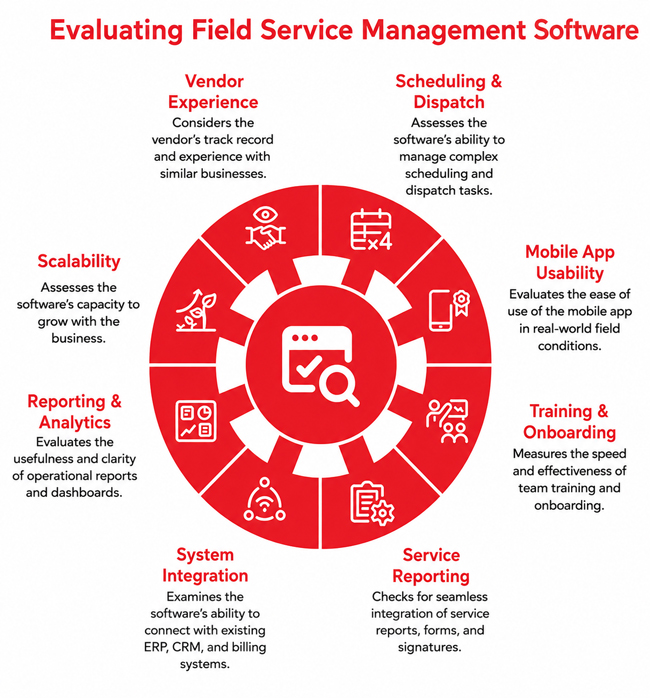
It is good to be practical when you compare options. The platform that you use should be able to support how your team works, rather than how a vendor wants you to work.
Look closely at the following:
- How well it handles real scheduling and dispatch needs, not just basic calendar management
- Whether technicians can use the mobile app easily in live field conditions
- How quickly your team can be trained and onboarded
- Whether it supports service reports, forms, photos, signatures, and status updates without extra hassle
- How cleanly it connects with your ERP, CRM, billing, or customer systems
- Whether reporting gives you useful operational visibility instead of generic dashboards
- How well the platform can scale as job volume, territories, and team size increase
- Whether the vendor has experience serving businesses like yours
This is also the right stage to ask how different best-of-breed software companies support implementation, onboarding, and long-term success. The strongest best-of-breed software is not just feature-rich. It makes daily execution smoother. And when you are choosing the best field service management software for a small business, that kind of fit usually matters far more than how many broad modules appear in a brochure.
Praxedo belongs in that shortlist conversation because small businesses often need a platform that supports field teams in a focused, usable, and scalable way.
For a deeper comparison, read our Best-of-Breed Software vs ERP Systems whitepaper.
Conclusion
For small businesses, the right FSM is about fit, not feature volume. A general platform may work in some cases, but best-of-breed software is often the better choice when field service is central to the business and day-to-day execution needs more depth.
That is why best-of-breed solutions continue to stand out for growing service teams. Book a demo with us to see how Praxedo can support your team today and scale with your business tomorrow.
FAQs:
1. What is best-of-breed software?
A best-of-breed solution is specialized software designed to perform a single task outstandingly, rather than a wide range of tasks.
2. When should a small business choose best-of-breed field service software?
When a general system becomes too large to handle scheduling, dispatching, mobile workflows, or service complexity, a small business should consider when to switch to best-of-breed.
3. Are best-of-breed software solutions better than a general FSM?
Best-of-breed software solutions are not always better, but they are usually more suitable for businesses that rely heavily on field service and require more operational support.
4. What are the main best-of-breed software advantages for small businesses?
The biggest advantages of best-of-breed solutions are stronger field functionality, easier technician adoption, and better alignment with real service workflows.
5. What is the difference between the ERP-native field service add-on and the best-of-breed FSM solution?
ERP add-ons can be useful for system alignment, whereas best-of-breed tools can provide superior field experience.
6. How do I evaluate the best field service management software for a small business?
The best field service management software for a small business is easy to use, mobile, with strong scheduling, reporting, and integrations, and it fits your service model.

Our similar articles.
-
- fsm
- AI in field service management
- carpet cleaning
How Carpet Cleaning Business Software Can Transform Your Operations
January 14, 2026
-
- Field Service Management
- Field Service Software
- mobile
- AI in field service management
The Power of Mobile-First: Why Mobile Devices Are Critical for Digital Transformation in Field Service Management
December 5, 2023
-
- IoT
- AI in field service management
- Augmented reality
- Virtual reality
Top Field Service Management Trends to Watch Out for in 2025
January 21, 2025