
- AI in field service management
- ai-powered scheduling
- AI-powered service scheduling software
- field service scheduling optimization
Don’t Just Fill Schedules, Optimize Your Network
Key Takeaways:
Here is a quick overview of how AI scheduling helps service businesses improve routes, balance workloads, and respond faster to daily changes.
Key Takeaways
- Beyond the Calendar: AI-driven scheduling minimizes wasted windshield time and service gaps while promoting balanced workloads across your entire team.
- Multi-Variable Matching: Field service schedule optimization aligns job assignments by technician skill, precise location, real-time urgency, and parts availability.
- Agile Adaptability: AI enables instant, automated route adjustments when delays, cancellations, or emergency calls disrupt the day.
- Network-Wide Impact: The highest operational returns come from optimizing the entire technician network rather than managing individual schedules in isolation.
A full calendar can feel reassuring. Everyone is booked, and the day looks busy. But when you look closer, that same schedule may hide long drives, poor job sequencing, overloaded territories, and technicians rushing from one stop to the next. Busy does not always mean efficient, and most field teams feel that truth sooner or later.
That is why more service businesses are shifting toward AI-powered scheduling. The goal is no longer just filling empty slots. It is building a day that better uses people, routes, and timing. For companies trying to grow without more friction, that change can be a relief.
Why a Full Schedule Can Still Be Inefficient
Many scheduling problems are invisible until the day starts falling apart. A technician might have five jobs lined up, but if two are on opposite sides of town, one requires a skill set they don’t have, and another is miles away from a logical cluster, that day is leaking time.
That is where field service schedule optimization matters. Instead of measuring success by how many appointments fit into a calendar, it asks whether the overall plan actually supports better performance. Are travel times realistic? Are jobs placed in the best order? Are your strongest people being used where they can add the most value?
When service leaders ask those questions, they move into field service scheduling optimization. Customers do not care how full your board looks. They care whether you arrive on time, solve the issue, and communicate clearly along the way.
What Network Optimization Really Means in Field Service
Network optimization sounds like a big idea, but it is practical. It involves viewing scheduling as a network and not a list of individual appointments. The right technician must be assigned to the right task, in the right area, at the right time, without causing waste in other parts of the day.
That is hard to manage manually, especially when conditions keep changing. Strong AI-powered service scheduling software helps teams spot better options faster. It can highlight a nearby technician, a smarter sequence, or a better use of open capacity before small inefficiencies become bigger delays.
At its core, field service scheduling optimization integrates routing, workload balance, service quality, and response time into a single decision-making process. That broader view helps teams stop reacting and start guiding the day.
Signs Your Scheduling Process Needs an Upgrade
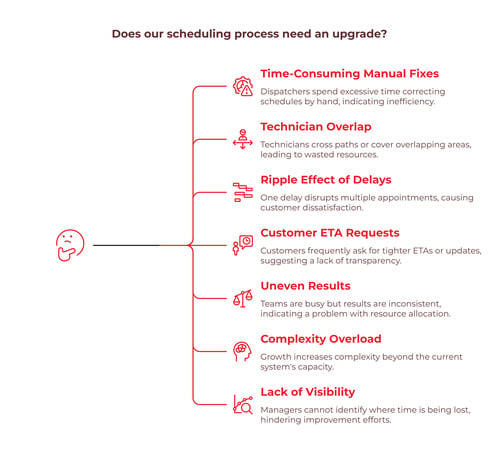
If any of these issues sound familiar, your process may be holding the operation back:
- Manual Firefighting: Dispatchers spend hours every day manually shuffling schedules and re-assigning jobs.
- Overlapping Territories: Technicians frequently cross paths, double back, or cover the same neighborhoods on the same day.
- The Domino Effect: A single delay in the morning throws off every subsequent appointment on that technician’s schedule.
- Customer Friction: Customers consistently call in demanding tighter ETA windows or real-time arrival updates.
- Diminishing Returns: Your team is working harder than ever, yet overall margins and job completion rates remain flat.
At that point, AI-powered workforce scheduling solutions stop being “nice to have” tools. They become part of running a more stable, less stressful service business.
What Inefficient Scheduling Looks Like on the Ground
Scheduling problems do not stay on a screen for long. They are part of the daily experience of technicians, dispatchers, and customers. When schedules are built reactively rather than strategically, the pressure spreads across the entire operation.
Technician Frustration Builds Quickly
Technicians are usually the first to feel the effect. The day may be frustrating even before it begins due to last-minute changes, poorly planned routes, and uneven job assignments. In the long run, such inconsistency may affect morale, productivity, and the quality of service they deliver.
Reactive Dispatching Creates More Pressure
For dispatchers, it is not typically a matter of effort. It is the need to respond all the time. When the scheduling process relies too much on manual decisions, even a minor delay or an emergency call can disrupt the rest of the day. Teams are not improving the schedule; rather, they are stitching it together as they proceed.
Disconnected Systems Slow Everything Down
Even the system itself may cause issues. If scheduling tools are not connected to real-time data, route information, or technician availability, decisions are made with only part of the picture. That slows reaction time and complicates adaptation without interruption.
Customer Expectations Keep Rising
The customers are also affected. Service windows, communication, and reliability expectations are greater than ever. Even a busy team may seem disorganized when scheduling fails. This is why efficiency is not the only thing about better planning. It is also about delivering a service experience that people can rely on.
How AI Makes Scheduling Smarter
Field service rarely follows the original plan for long. Traffic changes, jobs run over, customers reschedule, and urgent work appears out of nowhere. The real challenge is not just creating the first schedule. It is making smart decisions after the day begins to shift.
AI-powered scheduling tools can genuinely help here. They review several factors at once, including technician skill sets, availability, route quality, timing constraints, and job priority. A dispatcher can also do that, but not as fast when dozens of moving parts are all competing to be heard.
That shift is happening across business operations more broadly. According to McKinsey’s 2025 global survey, 88% of respondents say their organizations are regularly using AI in at least one business function, which helps explain why AI-driven scheduling is gaining attention in service environments.
Using AI-based field service scheduling, teams can make changes more quickly without making each change a scramble. When the plan is interrupted by real life, routes become better, wasted mileage is reduced, and the schedule becomes more resilient. Praxedo helps service teams make that shift. Instead of treating scheduling like a daily fire drill, the platform supports better decisions across the network. For businesses that want growth without chaos, that difference feels significant.
The Business Benefits of Optimizing the Network

Higher Technician Productivity: Technicians spend less time in traffic and more time on-site doing high-value, billable work.
Reduced Overhead and Travel Costs: Smart routing dramatically cuts fuel consumption, idle time, and vehicle wear-and-tear.
Rapid Emergency Response: A highly visible, optimized network can absorb urgent service requests smoothly without disrupting planned maintenance routes.
Elevated Customer Experience: Reliable arrival windows, automated updates, and faster first-time fix rates turn customers into lifelong advocates. Strong field service enhanced scheduling, and optimization help create that sense of confidence from the first update to the final visit.
Balanced Workloads: Work is distributed evenly across your team based on capacity and territory, reducing technician burnout and improving retention.
Flawless SLA Compliance: Automated prioritization ensures you always meet your contractual commitments, protecting key accounts and avoiding penalties.
What to Look for in Modern Scheduling Technology
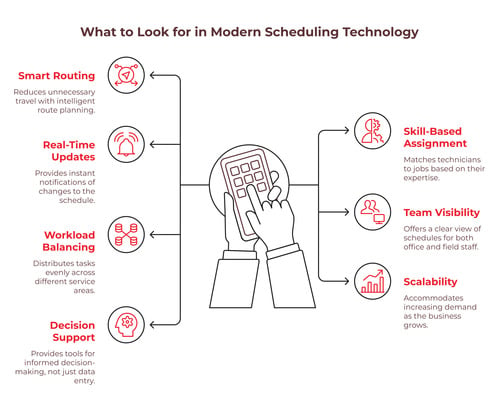
If you are evaluating platforms, look beyond basic dispatch screens. The best systems support both planning and live adjustment.
- Dynamic Routing: Automatically calculates the most efficient paths to minimize mileage and windshield time.
- Skill-Based Matching: Pairs the complexity of the job with the exact credentials of the technician.
- Real-Time Dispatch Updates: Instantly syncs schedule changes directly to the technician’s mobile app.
- Unified Field-to-Office Visibility: Ensures dispatchers and field crews are looking at the exact same real-time data.
- Territory Workload Balancing: Prevents some territories from being overloaded while others sit idle.
AI-powered workforce scheduling solutions help service teams stay flexible under pressure. The same goes for platforms included among the best field service tools for technician scheduling and route optimization, because the real value is not only booking work. It is improving the network’s performance. Praxedo is designed around that bigger picture.
Conclusion
Filling schedules is only the starting point. The real advantage comes when your operation connects jobs, technicians, territories, and timing more smartly. That is how service businesses reduce friction, protect margins, and create a better experience for customers and teams alike.
With the right tools, AI-powered scheduling solutions can help turn a busy operation into a more controlled one. The same is true for field service enhanced scheduling and optimization, which helps you look beyond the board and manage the network as a whole. Praxedo supports that kind of progress, giving service organizations a stronger path toward consistency, efficiency, and growth. Book a demo to see how Praxedo can help you optimize scheduling, improve technician efficiency, and strengthen service performance across your network.
FAQs:
1. Why can a full calendar still lead to poor results?
A packed day can still include weak routing, uneven workloads, and excessive drive time. That is why field service schedule optimization matters more than simply keeping technicians busy.
2. How do modern scheduling tools improve daily service?
They help teams make better decisions about routes, timing, and assignments. Many service businesses adopt modern scheduling tools to have smoother days, not fuller ones.
3. What is the value of AI in scheduling?
It helps dispatchers react more quickly and choose better options as the day changes. In real operations, it creates more control without taking people out of the loop.
4. What should a business expect from better scheduling software?
They should expect stronger routing, better visibility, and easier real-time adjustments. That is why many growing teams look for AI-powered service scheduling software when manual planning starts slowing them down.
5. Is AI-based scheduling only for large service teams?
No. Smaller and mid-sized operations can benefit as well, especially as complexity rises. Many teams begin with AI-powered field service scheduling because it helps them scale in a calmer, more reliable way.
6. What separates modern scheduling platforms from older systems?
Modern tools support better network-level decisions, not just calendar management. That is what makes AI-powered scheduling solutions more useful than older systems that only fill time slots.

Our similar articles.
-
- fsm
- AI
- AI in field service management
- agentic ai
From 3-Ring Binders to Agentic AI: What JLG’s Transformation Teaches Every Field Service Leader
April 26, 2026
-
- wastewater management
- fsm
- AI in field service management
- sewer maintenance
Sewer Maintenance Software – Reducing Downtime of Operations
September 15, 2025
-
- fsm
- AI in field service management
- Heavy equipment
- heavy equipment management software
How Software for Equipment Dealers Can Streamline Operations
November 18, 2025