
- AI
- AI in field service management
- fsm
- GenAI
- generative ai
From Theory to Reality: How GenAI Is Finally Making On-Demand Field Service Dispatch Possible
Key Takeaways:
The barriers that blocked Uberization in 2024 haven’t disappeared; GenAI has engineered around them.
- In 2024, Praxedo identified job qualification complexity and skilled workforce shortages as the two core barriers to on-demand field service dispatch
- In 2026, Generative AI and Voice interfaces have bridged the expertise gap, allowing 1099 contractors to service high-tech robotics.
- The W-2 to 1099 workforce shift, powered by pay-per-usage service contracts, removes the fixed payroll cost that made on-demand models uneconomical
- Voice AI technician briefing and debriefing creates a self-updating knowledge flywheel, solving the institutional memory problem of transient contractor workforces
In early 2024, Praxedo published a deep dive titled “Can Uber-like scheduling management apply to Field Service Dispatch?” Our conclusion was cautious. Two stubborn barriers, the job qualification problem and the workforce structure challenge, made true on-demand dispatch nearly impossible for complex, high-skill service environments.
Fast forward to 2026. At Field Service Next West, we heard from Aaryan Agrawal, founder of Farhand, who was not theorizing about on-demand field service dispatch with AI; he was building the infrastructure for it. The barriers we identified have not disappeared. They have been engineered around, and the technology doing the engineering is Generative AI. In practical terms, this is the early Uberization of work in complex field service.
What Were the Two Barriers That Made Uberization Impossible in 2024?
Our 2024 analysis identified two blockers that separated field service from the simplicity of ride-sharing. Those same blockers also explain why true Uberization of services remained out of reach.
The first was the job qualification barrier. Unlike booking an Uber, where the only variable is getting from A to B, a field service job requires a detailed technical diagnosis before dispatch. Customers often cannot explain what is wrong with complex equipment. Sending the wrong technician with the wrong parts wastes an entire service visit. Automating dispatch without solving the qualification first was not viable.
The second was the barrier posed by the workforce structure. Uber works because drivers sit available, waiting for demand. Field service companies cannot replicate that model with skilled technicians. Training takes months. Profit margins do not support a standing army of specialists waiting to be called upon.
Combined, these obstacles rendered on-demand dispatch of anything beyond simple, low-complexity jobs economically impractical. That was 2024. Both are cracking in 2026, which is exactly why customer service uberization is now being discussed more seriously in field operations.
How Does GenAI Solve the Job Qualification Problem?

Farhand’s approach removes the human from the qualification step entirely. Instead of requesting a customer to explain a fault, the platform employs AI as a defence mechanism.
The system examines log files, error codes, and sensor data of the malfunctioning equipment using remote AI diagnostics before anyone is sent. The AI detects the fault, finds the probable cause, and creates an accurate job specification. A contractor will have the specific parts required and step-by-step instructions loaded on their device by the time they leave the site.
“AI is now good enough to guide someone who is generally smart and handy to service technology they have never seen before. The AI handles the software commands and diagnostics; the technician handles the physical motor or sensor replacement.” — Aaryan Agrawal, Founder, Farhand.
The job qualification automation problem, the one we called unsolvable in 2024, now has a working answer. This is also what real service Uberization starts to look like in a high-skill environment.
Can On-Demand 1099 Contractors Now Service High-Tech Equipment?
The workforce model that makes this viable is as important as the technology itself. Farhand does not employ technicians in the traditional sense. It operates a managed service marketplace field service model, tapping into existing networks of electromechanical contractors, automotive technicians, drone repair specialists, and IT hardware engineers available on a 1099 basis.
This 1099 contractor field service model removes the most crippling cost in traditional service operations: fixed payroll. Under the old model, an OEM needing national coverage had to either build a large W-2 team or depend on expensive authorized service partners with long lead times. Under the new model, they pay for outcomes, not headcount. That shift reflects both the Uberization of the workforce and the broader Uberization of business models now entering field service.
Pay-per-usage service contracts mean an OEM headquartered in San Francisco can dispatch a repair in Ohio at $110 per hour, no travel costs, no benefits overhead, no idle time on the books. The W-2-to-1099 workforce shift is not driven solely by cost-cutting; it is enabled by AI, which closes the electromechanical skills gap that previously required product-specific training for every new device type. In other words, the Uberization of the workforce becomes viable only when AI can carry part of the expertise burden.
How Does Voice AI Stop Knowledge From Walking Out the Door?

One concern we flagged in 2024 regarding transient contractor workforces was the loss of institutional memory. If technicians rotate in and out on a gig basis, how does an organization retain the knowledge that makes service better over time?
Farhand’s answer is the field service knowledge flywheel, powered by voice AI. The process works in two directions. That matters because customer service Uberization fails quickly if knowledge disappears every time a contractor leaves the network.
Before a job, the contractor receives an AI technician briefing via voice on the drive to the site. The AI surfaces relevant fault history, likely repair steps, and any site-specific context, all in under two minutes. No documentation review. No call to dispatch.
After the job, the AI technician debriefing captures everything the contractor observed. They speak naturally about what they found and fixed, and the AI converts that into structured documentation that immediately updates the central knowledge base.
This compounding effect is significant. Tribal knowledge that once lived inside the heads of long-tenured W-2 employees is now systematically captured and made searchable, regardless of who performed the work. The learning curve that previously justified a permanent specialized workforce is dramatically shortened. That is a major step toward scalable Uberization of services.
What Does This Mean for OEMs and Field Service Leaders?
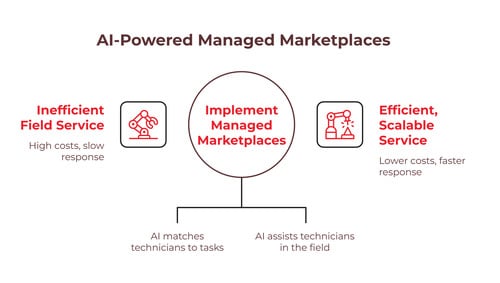
The implications extend well beyond robotics startups. For any organization managing a growing installed base of technology, the emergence of on-demand field service dispatch with AI reshapes service strategy in three key ways. It also pushes the Uberization of business from theory into operating reality.
- Lower Entry Barriers for OEMs: New robotics companies can scale service globally without building a 500-person team.
- Increased Technical Literacy: AI acts as a “Force Multiplier” for the existing labor pool.
- Efficiency over Tradition: The focus has shifted from who is on the payroll to how fast the asset is back online.
At Praxedo, we believe the core of this transition remains a streamlined end-to-end process. Whether your technicians are employees or contractors, they require a best-of-breed mobile toolbox to bridge the gap between human handiness and robotic complexity.
Conclusion
Are we fully there yet? For simple-to-mid complexity electromechanical repairs, yes — on-demand field service dispatch with AI is operational, not theoretical. For highly regulated, safety-critical, or certified work, the hybrid model still applies: W-2 specialists supported by AI, with contractors handling volume work around them. That still marks a meaningful Uberization of field service work, even if the transition remains partial.
Whether your technicians are employees or contractors, they need a mobile-first FSM platform built for the speed and flexibility this new model demands. See how Praxedo supports the future of flexible, AI-driven field service. Request a demo today.
FAQs:
1. Can a general technician really service complex robotics using AI guidance?
Yes – AI-assisted repair platforms offer step-by-step guidance in real-time, enabling contractors with general skills to work on hardware they have never previously touched, as long as they have experience in electromechanical work.
2. What is the difference between W-2 and 1099 models in field service?
W-2 workers are on regular payroll with guaranteed availability; 1099 contractors are paid per job with no recurring overhead and are better suited to on-demand dispatch made possible by AI.
3. What is pay-per-usage field service pricing?
A contract model where OEMs pay only when a repair is performed, per job or per hour, rather than maintaining a full-time employed service team, significantly reduces fixed operational costs.
4. How does voice AI capture knowledge from field technicians?
Technicians speak a natural debrief after completing a job; voice AI converts that into structured documentation that immediately updates the central knowledge base for future contractors.
5. What is a managed service marketplace in field service?
A platform that links OEMs to a vetted network of 1099 contractors, dispatch, compliance, and payment management, allowing on-demand coverage without the expense of a full-time, permanent workforce.
6. Does AI replace field technicians or make them more effective?
AI is a force multiplier; it provides diagnostic expertise and real-time advice that a broadly skilled contractor can competently manage without displacing human presence in the field.

Our similar articles.
-
- Mobile App
- HVAC
- fsm
- ai field service management
Why is mobile field service software for HVAC essential in 2025? Your Complete Guide
July 8, 2025
-
- fsm
- AI
- AI in field service management
- GenAI
- generative ai
From Theory to Reality: How GenAI Is Finally Making On-Demand Field Service Dispatch Possible
April 26, 2026
-
- customer experience
- fsm
- field service companies
- purpose-driven
- Service-first
Powered by Purpose: Building a Company Culture That Puts Service First
October 21, 2025