
- AI in field service management
- ai scheduling
- fsm
- smart scheduling
How Does CBRE Schedule Tens of Thousands of Technicians Across 100 Countries?
Key Takeaways:
Here is what the CBRE and Timefold case study reveals about enterprise technician scheduling at scale:
- Manual scheduling has a hard ceiling; once a field operation exceeds 50 technicians, the number of valid schedule combinations becomes humanly impossible to process, and quality collapses fast.
- One violation of a hard constraint does not just waste one trip. It renders the entire day’s schedule invalid, triggering a cascading failure across every job on the board.
- CBRE cut fleet mileage by 43% and saved 30 minutes per technician per day by replacing manual dispatch with an AI-driven constraint-based scheduling optimization engine.
- AI does not eliminate dispatchers; it removes the combinatorial burden so they can focus on exceptions, escalations, and client relationships.
CBRE is the largest commercial real estate firm in the world, managing over 155 billion in assets across over 100 countries. Beyond that scale lies one of the most complex global workforce scheduling problems in any business: coordinating tens of thousands of engineers and technicians across thousands of client locations daily.
As the operation grew, the cracks became impossible to ignore. CBRE partnered with Timefold to replace manual dispatch with an AI-driven optimization engine, and the results speak for themselves. It also gave planners a clearer drag-and-drop scheduling workflow for handling daily changes.
At Field Service Next West, CBRE and Timefold took the stage to share how the world’s largest commercial real estate company replaced manual dispatch with an AI optimization engine — and the measurable results that followed.
What Makes Enterprise Technician Scheduling So Difficult to Manage?
Multi-region field technician dispatch at CBRE’s scale is not a simple logistics problem — it is a constraint multiplication problem. Every variable added does not increase complexity linearly; it multiplies it exponentially.
Consider what CBRE manages simultaneously. Technicians carry specific certifications, and many clients request the same individual because that person already knows their systems. There are regional compliance regulations in 30+ locations. The time zones, shift patterns, and local labour regulations vary by country. And planning cannot be done day by day; operations must be plotted out today, tomorrow, this week, and the next month simultaneously.
Multi-horizon workforce planning is extraordinarily difficult because a decision made for Tuesday affects the availability pool for Thursday. A skills mismatch on one job ripples into delays on three others. At this volume, a single scheduling error is not an inconvenience; it is an operational crisis. A live drag-and-drop scheduling view can also help dispatchers see those dependencies more clearly.
Why Does Manual Scheduling Break Down at Scale?
Manual scheduling has a scale ceiling that most growing field operations eventually hit hard. The structural problem is combinatorial. When technician numbers exceed roughly 50, the number of possible valid schedule combinations grows factorially. No human dispatcher, no matter how experienced, can optimize at that level. The dispatcher’s cognitive load becomes unsustainable long before the math does, especially in manual-scheduling environments.
Then there is the scheduling feasibility problem. Hard constraints, rules that cannot be broken, act as all-or-nothing gatekeepers. Sending a technician without the right certification to a precision electrical job does not just waste that trip; it also risks injury. It makes the entire schedule invalid. Every job downstream of that violation is put at risk.
The cost of unassigned work orders compounds the damage further. When jobs go unplanned, companies face a binary choice: hire more headcount to absorb the overflow, or push work to the next day and erode service quality. Neither is acceptable at enterprise scale.
What Is Constraint-Based Scheduling and How Does It Work?
CBRE integrated Timefold’s engine via API directly into their existing software; no wholesale system replacement required. The engine translates all the rules of operation into two categories. This matters for companies that want optimization behind a familiar drag-and-drop scheduling tool.
Hard constraints cannot be compromised: skill requirements, shift limits, certifications, and regional compliance rules. Any schedule that contravenes any of these is rejected as infeasible. Soft constraints are optimization goals: travel time, cost, workload balance, and client preferences. These are the levers the AI pulls once all hard constraints are satisfied.
The power of constraint-based scheduling optimization lies in what it evaluates simultaneously. Where a human dispatcher makes sequential best-guess decisions, the AI assesses the entire job-technician matrix at once, weighing every possible assignment against every constraint and surfacing the schedule that scores highest across all variables combined.
For CBRE specifically, Timefold built a custom coverage-area constraint tailored to their operational model, demonstrating the flexibility of modern engines. Pre-built optimization models also enabled CBRE to move from integration to live deployment quickly, without months of configuration, while supporting a more practical drag-and-drop schedule workflow for dispatch teams.
How Often Does the AI Re-calculate Routes During the Workday?

The morning plan is only the beginning. Field operations are chaotic, jobs overrun, emergencies arrive, and technicians call in sick. Every disruption in a manual environment requires dispatcher intervention, which is time-consuming and inefficient.
The engine of Timefold performs dynamic re-optimization on-the-fly, re-calculating assignments after every 5, 10, or 60 minutes based on operational requirements. When a disruption hits, it does not just patch the affected job; it reconsiders the entire remaining schedule to find the globally optimal response, not just the locally convenient one.
This is the difference between reactive scheduling and genuinely intelligent work order assignment logic. The dispatcher remains in control, reviewing an AI-generated recommendation rather than rebuilding from scratch with every change, often surfaced through a drag-and-drop scheduling tool.
What Results Did CBRE Actually See?
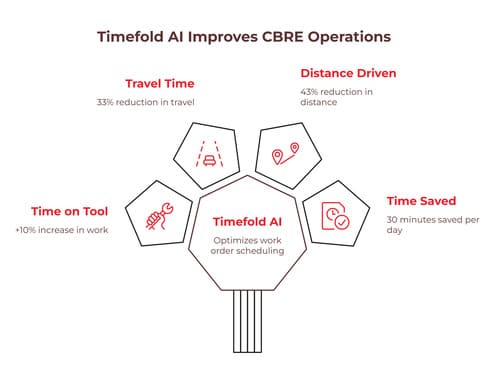
CBRE conducted a formal impact study using real work-order data. The findings were significant across every metric.
- +10% increase in “time on tool” (technicians spending more time working, less time idling).
- 33% reduction in travel time.
- 43% reduction in total distance driven.
- 30 minutes saved per day, per technician.
Those individual savings compound dramatically at enterprise scale. Thirty minutes per technician, multiplied across tens of thousands of engineers globally, represents a massive recovery of productive capacity, without adding a single headcount.
The environmental impact is equally significant. A 43% reduction in fleet mileage is not just a cost saving; it is a measurable contribution to ESG reporting goals, reducing vehicle emissions across a global operation in a way that manual scheduling could never systematically achieve.
Does AI Scheduling Replace Dispatchers or Make Them More Effective?
The CBRE case study clearly answers this: AI scheduling changes the dispatcher role, but it does not eliminate it.
In a manually-scheduled operation, most of a dispatcher’s day is consumed by combinatorial work, figuring out who goes where, in what order, under what constraints. That is exactly what the AI absorbs.
The operational efficiency gains CBRE achieved did not come at the expense of its dispatch team. They came from giving that team a tool that handled the computational heavy lifting, freeing them to operate at a level no algorithm can fully replicate. In practice, that often means moving away from manual-scheduling habits and into a more responsive drag-and-drop scheduler workflow.
Conclusion
The CBRE and Timefold case study is not just a story about one company solving a scheduling problem. It is proof that enterprise technician scheduling at scale requires a fundamentally different approach, one built on optimization, not coordination.
Manual dispatch has a ceiling. Constraint-based scheduling does not. For operations directors managing growing workforces, the question is no longer whether this technology works; it is whether it works. The question is how quickly your organization can close the gap. For many teams, adoption becomes easier when optimization is paired with a practical drag-and-drop schedule interface.
Want to see how Praxedo’s AI-powered scheduling tools can work for your field operation? Request a demo today.
FAQs:
1. What is enterprise technician scheduling at scale?
It is the process of assigning and routing large numbers of field technicians — typically 50 or more — across multiple locations using automated optimization systems that manual scheduling cannot handle effectively.
2. What is the difference between hard and soft scheduling constraints?
Hard constraints are non-negotiable rules, such as skill requirements or shift limits — violating them renders a schedule invalid. Soft constraints are optimization targets, such as minimizing travel time, that improve schedule quality without rendering the schedule infeasible.
3. Why does manual scheduling fail for large field operations?
Above roughly 50 technicians, the number of valid schedule combinations becomes computationally impossible for a human to evaluate, leading to inefficient assignments, unassigned work orders, and frequent constraint violations.
4. What does “time on tool” mean in field operations?
Time on tool is the ratio of a technician’s working day to the time spent actively working on job tasks, not travelling or waiting – it is a direct measure of workforce productivity standards and operational efficiency.
5. How does AI scheduling reduce a company’s carbon footprint?
AI scheduling directly leads to fleet mileage savings by optimizing routes and eliminating unnecessary trips, with CBRE reducing its fleet distance by 43%, which can be translated into quantifiable reductions in vehicle emissions, reinforcing ESG reporting goals.
6. Can an AI scheduling engine integrate with existing field service software?
Yes — modern engines like Timefold are delivered via API, meaning they connect to existing platforms without requiring organizations to replace their current systems or overhaul established workflows.

Our similar articles.
-
- Mobile App
- HVAC
- fsm
- ai field service management
Why is mobile field service software for HVAC essential in 2025? Your Complete Guide
July 8, 2025
-
- fsm
- field service technician
- AI in field service management
- field service knowledge base
No Technician Left Behind: How Crown Equipment is Revolutionizing Support Through Vertical Integration
May 25, 2026
-
- fsm
- plumbing
- AI in field service management
How to Choose the Best Software for your Plumbing Business
September 6, 2025