- Field Service Management
- fsm
- scaling revenue
Service as a Revenue Engine: Leading the Next Wave of Growth
Key Takeaways:
A panel of global service leaders at Field Service Next West 2026 made the case that service as a revenue engine is no longer a strategic option; it’s a survival imperative for any high-tech or industrial business.
- Outcome-based contracts beat billable hours. Companies that monetize results see 2 to 5% more compounded growth and 3 to 8% higher total profit.
- Sales teams need new muscles. Selling digital services requires a different skill set than selling hardware, which is why service-led sales enablement
- AI must serve the customer problem, not the org chart. Siloed AI tools create innovation fatigue, while enterprise alignment delivers ROI.
- Standardize globally, sell locally. A “Franchise and Governance” model lets multinational service organizations scale AI and processes rapidly.
- Stop using the word “pilot.” Every initiative should be commercially viable from day one.
How can service departments transition from cost centers to profit centers?
The consensus from leaders at Tetra Pak and Siemens is that revenue follows value. By moving to outcome-based service models, where customers pay for uptime or cost reduction rather than just “wrench time,” companies can achieve significantly higher compounded growth and profit margins.
Turning service into a revenue engine requires precise tracking of outcomes. Discover how Praxedo’s field service management platform, including technician performance tracking and ERP/CRM connectors, provides the transparency needed to power outcome-based contracts.
The Full Story
This panel discussion from Field Service Next West 2026 brought together global leaders from Siemens Smart Infrastructure, Tetra Pak, Illumina, and Agilent Technologies to discuss the fundamental shift from treating maintenance as a cost to leveraging service as a revenue engine.
The session offered a rare look at how billion-dollar organizations are navigating the transition to outcome-based service and AI-driven revenue growth in field service. Additional perspective on the panel themes is available in Future of Field Service’s recap.
The Evolution of the Service Journey

The panellists represented a broad spectrum of maturity in the service lifecycle. While some, like Illumina, are in the early stages of transitioning from cost center to profit center, others, like Tetra Pak, have been monetizing services for over 20 years.
Sasha Ilyukhin (Tetra Pak) shared a powerful statistic:
“Companies that monetize their services and move toward outcome-based models see 2% to 5% more compounded growth and 3% to 8% higher total profit as a company.”
This data point reframes the entire conversation. Service isn’t just transitioning from cost center to profit center; done well, it can compound profitability faster than the core product business itself.
Strategies for Scaling Service Revenue
To move beyond basic repair tasks, the leaders highlighted three specific levers for scaling growth.
1. Transitioning to Outcome-Based Service Models
Instead of invoicing for “wrench time” or parts, outcome-based service models invoice for specific results, such as uptime guarantees, predictable costs, or sustainability targets. For Tetra Pak, nearly half of its $2.3 billion service business is now driven by these specific outcomes. The lesson is that monetizing technical support and digital services isn’t a side hustle to product sales; it’s a parallel growth engine that customers actively want to buy.
2. Service-Led Sales Enablement
Brad Haeberle (Siemens) noted that growth is often a “salesperson game.” However, selling complex digital services requires a different skillset than selling hardware. Siemens implemented a service-led sales enablement layer, with experts who hand-hold traditional sales teams through their first digital service deals, creating a massive scaling effect. This model turns service-led sales enablement from a training program into a structural competitive advantage.
3. Proactive Monitoring and Predictive Uptime
Halleh Ahadian (Illumina) discussed the “commodity trap.” As high-tech hardware becomes standardized, the real value shifts to proactive service tools. By leveraging the “sea of data” from connected instruments, companies can use AI to build predictive models of uptime in high-tech manufacturing, preventing downtime before it occurs rather than reacting after the fact. See how Praxedo’s AI-powered scheduling supports proactive operations for service teams.
The Role of AI: Part of the Strategy, Not the Strategy
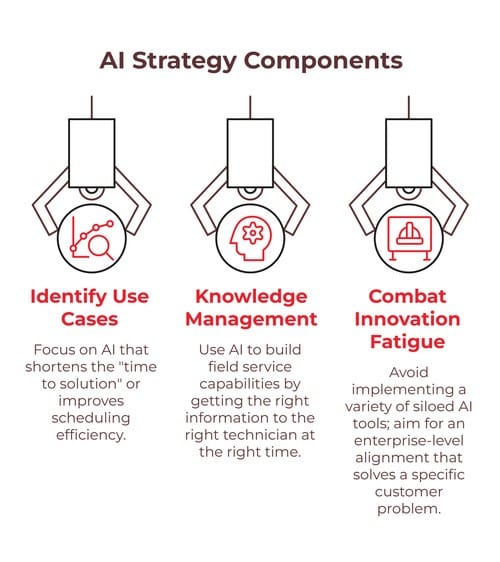
The panel cautioned against “AI for AI’s sake.” Armin Jehle (Agilent Technologies) emphasized that AI must be an integral part of product development for serviceability, built into the product from day one rather than retrofitted later.
- Identify Use Cases: Use AI to reduce “time to solution” or optimize scheduling.
- Knowledge Management: Leverage AI to develop field service capabilities by delivering the right knowledge to the right person at the right time.
- Avoid Innovation Fatigue: Don’t roll out a range of AI tools; strive for enterprise-wide alignment to solve a specific customer problem and enable AI-driven revenue growth in field service rather than in divisions.
When product development for serviceability is treated as a first-principles design choice, AI stops being an experiment and starts becoming a margin lever.
Overcoming Internal Friction
One of the most significant challenges discussed was the global service franchise and governance. To scale globally, organizations must be rigid in their processes and standards while remaining flexible in their go-to-market strategy.
Siemens uses a “Franchise and Governance” model, the same framework Brad Haeberle detailed in his keynote earlier in the event. Countries have total flexibility in how they sell to local markets but zero flexibility in the underlying technology stack or service standards. This “box” makes it possible to standardize field service processes across the globe without crushing local customer relationships, and it enables the company to rapidly deploy AI use cases across the enterprise rather than in isolated pockets.
Without this kind of global service franchise and governance, AI investments stay trapped as local pilots. With it, standardizing field service processes across the globe becomes the foundation that lets every region benefit from every innovation.
Conclusion
The panel’s collective message was strikingly consistent. The next wave of service growth won’t come from doing more of the same work more efficiently; it will come from rewriting the commercial model entirely. Outcome-based service models, structured monetizing technical support and digital services, and AI built into products from inception are no longer optional plays for industry leaders; they’re the cost of staying relevant.
Whether you’re at Tetra Pak’s 20-year head start or Illumina’s earlier-stage pivot, the path forward is the same: solve a real customer pain point, build the commercial model around the result, and let AI-driven revenue growth in field service scale what your people already do best. Ready to put the right operational foundation in place? Request a demo with Praxedo and see how a unified field service platform can power service as a revenue engine in your business.
FAQs:
1. What does “service as a revenue engine” actually mean?
It means treating service operations as a profit center that drives growth, through outcome-based contracts, digital services, and proactive support, rather than as a cost of post-sale support.
2. How much profit lift do outcome-based service models deliver?
According to Sasha Ilyukhin of Tetra Pak, companies moving to outcome-based models see compounded growth of 2 to 5% and total profit of 3 to 8% higher than under traditional billable-hours models.
3. What is service-led sales enablement, and why does it matter?
It’s a structured layer of service experts who coach traditional sales teams through complex digital service deals. Siemens uses it to scale digital service sales without rebuilding the entire salesforce.
4. How does predictive uptime for high-tech manufacturing create revenue?
By using connected-instrument data and AI to prevent downtime before it occurs, companies turn proactive monitoring into a premium service offering customers will pay for, a model Illumina is actively building.
5. What is the “Franchise and Governance” model in global field service?
A framework where local teams have total go-to-market flexibility but zero flexibility on technology standards. It enables fast, enterprise-wide AI deployment instead of fragmented regional pilots.
6. Why should companies stop using the word “pilot” for new initiatives?
Because “pilot” implies optional or experimental. The panel argued every new initiative should be commercially viable from day one, designed to deliver real customer value and revenue, not just learnings.

Our similar articles.
-
- Productivity
- Field Service Management
- Productivité
- Logiciel
- billing
- accelerated billing
Advantages of accelerated billing for field service companies
July 17, 2025
-
- fsm
- equipment maintenance
- equipment maintenance software
Key Reasons to Invest in Equipment Maintenance Software
March 5, 2025
-
- Technician
- Software
- Field Service Management
White paper: Field Service Management, why you’re probably doing it wrong
March 29, 2023